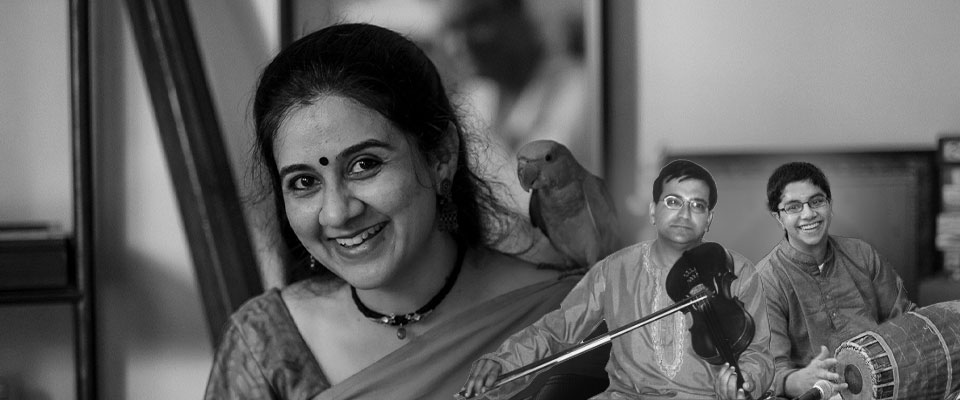
In class with Sri. Ramachandra Sastry at Kalakshetra

Why Carnatic music matters more than ever by Ludwig Pesch

For this musicologist and author, there are good reasons to believe that Carnatic music matters, perhaps more than ever and almost anywhere in the world.  So why not perform and teach it in the service of better education for all,…

The problem with Carnatic in the Bay

What would you like to do this Friday?” my husband asks. As I peruse the listings for concerts, I am amazed to see how many youngsters are performing Indian classical music. This is true not just in India but also in the US. From Boston to San Diego, classical music and dance schools are flourishing. And this isn’t a phenomenon limited just to big cities.

A Student Remembers; experiences accompanying MS Subbulakshmi

"Siddheshwari Devi, the doyen of Hindustani music is sitting on a chair, with a japa mala in her hand. Seated in front of her, are M.S.Subbulakshmi and her daughter Radha Viswanathan." R.K.Shriram Kumar, well-known carnatic violinist brings the scene from Kalki Gardens, MS’ home alive to the audience. In an intimate lecture-demonstration, from his unique vantage point as her accompanist and disciple, Shriram Kumar spoke of what made MS (whom he refers to as Amma) a truly special musician.

Setlur Ramaswami Iyer in San Diego

The Indian Fine Arts Society of San Diego is having a concert by Vidhushi Trivandrum Seethalakshmi. The concert is in memory of of S.A. Ramaswami Iyer (1855 -1936) the principal disciple of Walajapet Krishnaswamy Bhagavatar who was the son and disciple of Walajapet Venkataramana Bhagavatar .

70 Years Young; an interview with C.V. Chandrasekhar

The eminent Bharatanatyam dancer, choreographer, composer and teacher Prof. C.V. Chandrasekhar shared his memories as we were seated at the Kalakshetra auditorium with his dancer wife Jaya, waiting to watch the program of the evening. “You know I am 70 years old, don’t you,” he says with a wide smile and a chuckle.

Muthuswami Dikshitar – A Creative Genius

Dikshitar's songs bring in a mood of meditative devotion of sublime nature which transcends words and feelings. Dikshitar was probably the most complete classical composer and one of the most versatile men world has ever seen. He was a man who had early and purposeful exposure to Carnatic, Western, Persian, Arabic and Hindustani styles of music. Dikshitar had proficiency in different languages like Sanskrit, Tamil, Telugu, Hindi, English and different branches of academics such as History, Mythology and Science, not to mention proficiency in numerous musical instruments.

About the Music of South India

South India comprises a geographical area as large as that of Western Europe where four major languages (Tamil, Telugu, Kannada and Malayalam) are spoken. Although there are two metropolises (Madras, now known as Chennai, and Bangalore), and a few other important cities, most people still live in villages and small towns. This explains the great diversity of traditional South Indian music.

Why Carnatic Music?

As a Westerner interested in Carnatic music, I am frequently asked to explain my interest and to articulate what makes South Indian music special. Both Indians and Westerners ask the same questions. Since I did not grow up with it, but rather chose it for myself from among a broad range of world traditions, Carnatic music is special indeed. There is always a sense in which cross-cultural interactions serve not only to broaden one's horizons, but also to set one's own cultural identity more strongly in relief.

Composers

Although there are a great many well known composers of Carnatic music, it is customary to think of them as being pre and post “Trinity” which is the term by which Tyagaraja, Muthuswami Dikshitar and Syama Sastri have collectively come to be known.

Instruments

In South Indian music, the violin can function as either the lead voice or as an accompaniment. It is identical in construction to the western violin, however it is tuned in two ascending sets of perfect fifths (do sol, do sol.) The pitch of do is moveable, according to individual preference or, if accompanying, the soloists requirement.

Sangeetha Kalanidhis

The Madras Music Academy, which is one of the most prestigious institutions in the field of Carnatic Music, is located in Chennai, India. Since Aug.18, 1928, the academy has endeavored to provide various avenues to further the advancement of the science and art of Indian music. Annual music conferences are held every December to collect all information regarding music, maintain the library and publish a journal.

R.K.ShriramKumar

The following are excerpts and recordings from CCMA kutcheris and other programs held at Columbus Ohio. They are provided here for educational purposes and for your listening pleasure. Please respect the rights of the artists and do not copy or reproduce these in any manner.